Industrial Epoxy Flooring Chicago: Warehouse Epoxy Floors
Warehouse epoxy floors for Chicago and the suburbs, from distribution and storage buildings to production floors, prepared on your slab and quoted per project after a free site visit.
Warehouse and Plant Floors Around Chicago
About a quarter of U.S. freight trains and half of all intermodal trains pass through metro Chicago, and the region holds roughly 1.1 billion square feet of industrial space, so warehouse floors here work hard: aisles that take forklift turns all shift, dock aprons that get salt and snowmelt dragged in from October to April, production areas that see oils and degreasers. Retail and office spaces are on our commercial floors page; this one is for the buildings where something heavy eventually gets dropped.
Every recommendation starts with how the floor is used. A dry storage aisle, a wash-down bay and a loading dock want different build thicknesses and textures, so the crew asks what rolls across the floor, what spills on it and how often it gets hosed down, then recommends a solid-color epoxy system to match, with slip-resistant additives where floors get oily or wet.
The slab itself gets equal attention. Beneath Chicago lies dense glacial clay that holds water, and beside a dock door in January, when the normal high at O'Hare is 31.6°F, the concrete can sit far colder than the air in the building. Hence the site visit that opens every job: a moisture test on the slab, cracks and broken joint edges rebuilt, the surface diamond ground, and the work split into phases when the building cannot stop.
Retail, restaurant or office space instead? Our commercial floors page is the better starting point.
What a Warehouse Floor Has to Take
Forklifts, spills, wash-downs and a winter of salt off the trucks: the build is matched to each room and to your slab.
Chemicals
Chemical Resistant
Cutting fluid, hydraulic oil, diesel and degreaser all find the floor eventually. The topcoat gets picked for what really spills in your building, and should epoxy be the wrong answer for a chemical you run, you hear so plainly at the walk-through.
Traffic
Built for Forklift Traffic
Every shift the forklifts pivot on the same few square feet and the pallet jacks rut the same lanes. A full-build epoxy floor bonded to ground concrete takes that punishment; bare concrete dusts, pits and breaks up under it.
Grip
Anti-Slip Where It Matters
Wherever the floor turns slick, a slip-resistant additive goes into the topcoat: wash-down bays, the dock doors in a January snowstorm, maintenance areas that see oil.
Dock
Dock Aprons and Salt
Trucks drag road salt and snowmelt across the dock apron for months, and de-icers keep bare concrete saturated through every freeze. A coating bonded to ground concrete keeps the brine on top, where it can be squeegeed or mopped off.
Advice
Advice Based on Use
Tell us what the room does, what rolls through it and what spills on it, and you get a plain recommendation on build thickness, texture and finish, not a one-size-fits-all pitch.
Recoat
Planned for the Long Run
What makes a warehouse floor last is the prep underneath it: grinding, joint repair and a moisture test ahead of any coating. Years on, when the busiest lanes wear, a fresh topcoat usually goes over them with no tear-out.
Why coatings let go →From Walk-Through to Working Floor
Five steps to a floor your crew can work on, phased when the building has to stay open.
Facility Assessment
The crew walks the building with you, tests the slab for moisture, notes cracked joints and damaged areas, asks what the floor sees and maps where forklifts and people move. Schedule yours free.

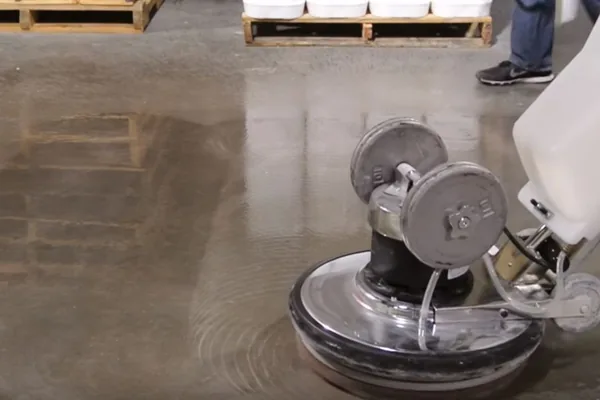
Industrial Slab Preparation
The floor is diamond ground, which strips old coatings with it. Cracks, chipped patches and broken joint edges are repaired, so the new system sits on sound concrete.
Primer
A primer coat sinks into the freshly ground concrete and anchors the coats that follow. Should the moisture test flag a problem, you learn what it means for the floor before anything else is applied.
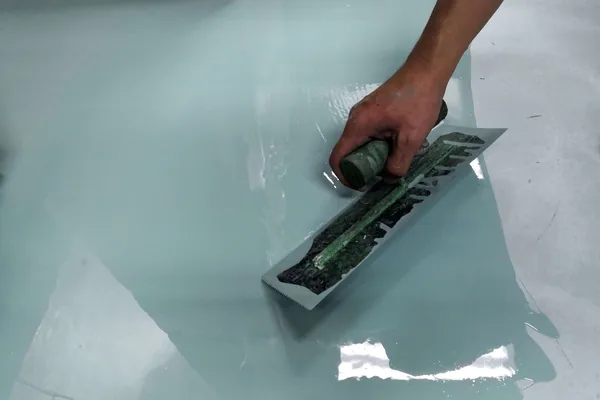
Coating System Application
Each area gets its own build: a full-build solid-color epoxy for busy aisles, a chemical-resistant topcoat where spills happen, and slip-resistant additives in wet or oily zones, all in the gray or color you pick.
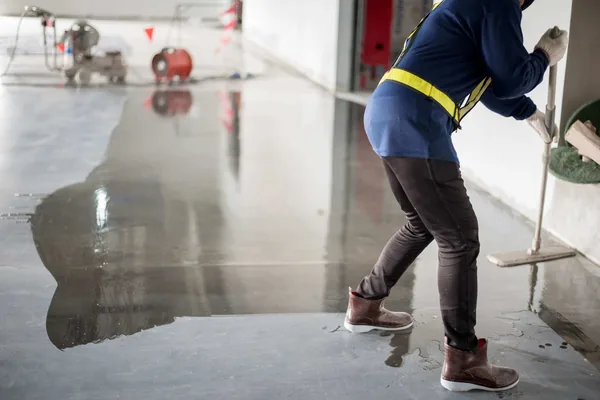
Curing & Handoff
How fast it cures depends on the product and the slab temperature, and a January warehouse and a muggy July one are different places, so the schedule leaves room for it. At handoff the crew walks you through cleaning and upkeep for your floor.

Ready to Start? Step 1 Is Free.
Book a free site visit to go over the floor, the traffic and the spills.
Industrial Finish Examples
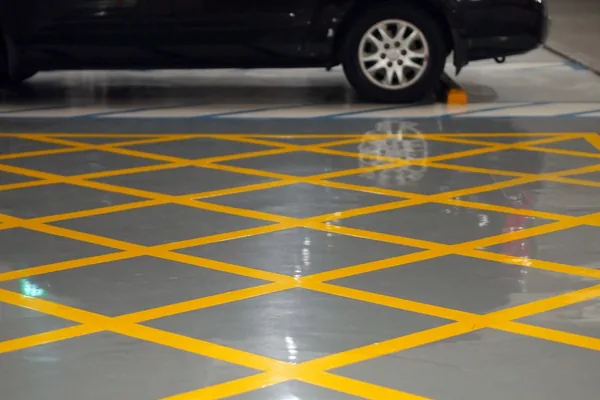
A warehouse floor, a safety-striped solid floor and a shop floor here; more warehouse and shop floors are in the full gallery.


Industrial Floor Questions
Answers for Chicago-area warehouse, plant and facility managers.
Buildings across Chicago and the suburbs, including:
- Warehouses and distribution centers
- Manufacturing and production areas
- Storage and stockroom floors
- Loading docks and aprons
- Fleet and maintenance bays
- Shop floors and workrooms
Every area is built for its own loads, spills and temperatures, and each job is priced per project after a free walk-through.
Through temperature and humidity, mostly. Each product has a temperature window, and next to an open dock door in January, when O'Hare's normal high is 31.6°F, the slab can run far colder than the air in the building. Summer flips it: with July dew points in the low 60s, a humid morning means a moisture reading on the slab before coating.
Install days are planned around the slab temperature and the product's own instructions, not the calendar.
Yes, within limits you hear up front. Epoxy floors resist oil, grease, fuel and most cleaning chemicals.
Strong acids and harsh solvents are a different conversation. Bring the exact list to the walk-through, and if epoxy is a poor match for something on it, you hear that straight.
More than a garage does, because the loads are heavier. Before any coating:
- The slab is tested for moisture
- Old coatings and the weak top layer are diamond ground off
- Cracks and spalled patches are filled
- Broken joint edges are rebuilt
- Oil-soaked spots are cleaned and ground back
- A primer coat ties the slab to the build
All of it is listed in the per-project quote, so there are no surprises once the forklifts move out.
Square footage, the state of the slab and the build decide it. A small shop floor goes quickly; a big distribution floor takes longer and is normally done in phases.
With phasing, one area stays in use while the next is coated. The timeline arrives with your estimate so you can plan shifts and inbound trucks around it.
Preview your facility floor.
Try finishes on a floor like yours and get a ballpark figure with your free-estimate request. Industrial floors are quoted per project after a site visit.
Open Floor Studio →