Walk into enough garages with a failed coating and you see the same picture. The finish has let go in a band a foot or two deep just inside the overhead door, chipped and curling, while the concrete under the cars and along the walls still looks fine. Outside, the apron is often scaling, its top layer flaked off in rough patches. In the Chicago area the two have the same cause: salt slush, water that freezes and thaws, and tires crossing the same strip every day. Both can be prevented, and the prevention happens before the first coat goes on.
Why the Threshold Goes First
The strip inside the door has the hardest job on the floor:
- The slush lands there. The moment a car stops, snowmelt full of road salt, brine and grit runs off the tires onto that strip. Chicago has reported spreading about 215,000 tons of salt a year on its streets; some of it comes home on every car.
- The water stays there. A garage slab is poured with a slight fall toward the door or a drain, so meltwater collects along the threshold instead of running away from it.
- The cold reaches it. O’Hare records freezing temperatures on about 121 nights a year, with an afternoon thaw on all but about 43 of them, and every time the door opens that edge is back in the outside air.
- The tires cross it. Wheels turn and brake on the same few feet, hot in July and wet and gritty in January.
Any weakness in the coating is found there first. Four weaknesses explain most of the failures we see.
Cause 1: A Slab That Was Never Ground
Epoxy holds on by mechanical grip, which means it needs concrete that is open and slightly rough. A trowelled slab is the opposite: dense and smooth from day one, and sealed further over the years by dust, tire dressing, oil and old sealer. The floors that fail early are usually the ones that got a wash and a store-bought kit on top of whatever was already there, which in a 1920s alley garage can mean several coats of old paint.
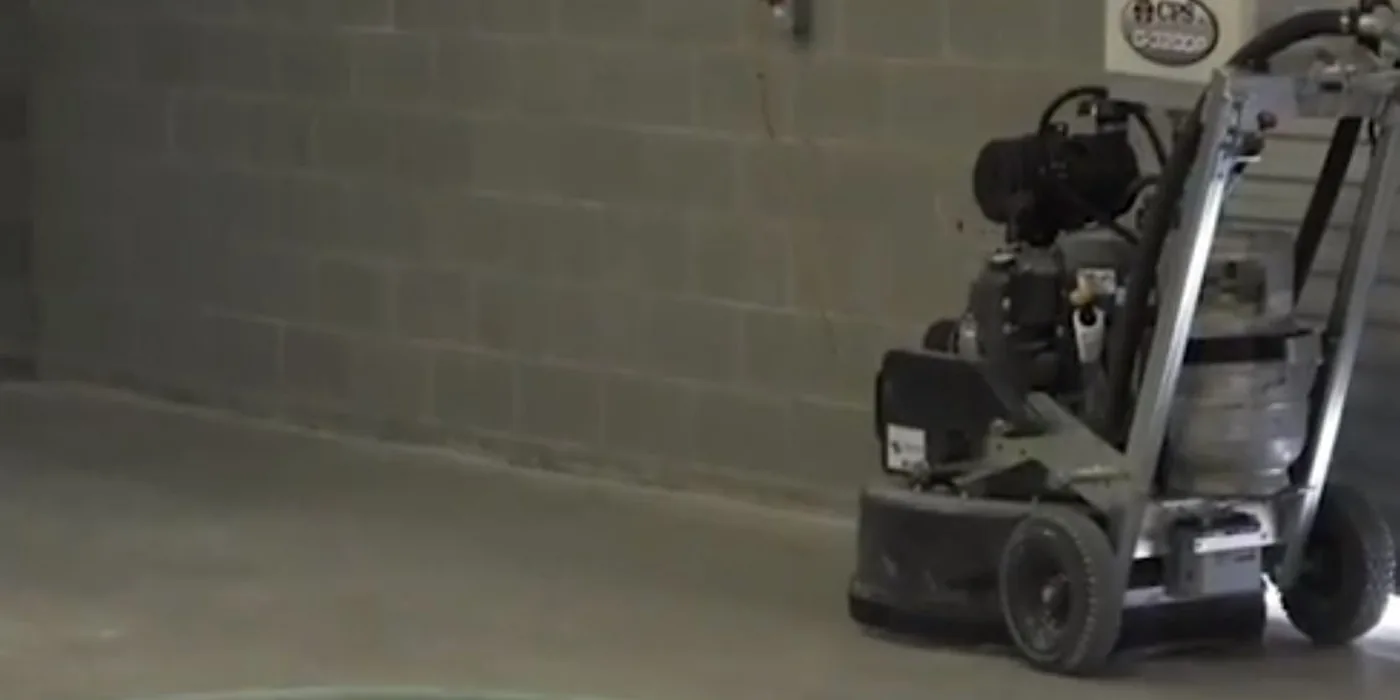
Diamond grinding is the answer, and every garage floor gets it. The grinder cuts off the weak surface paste, the sealers and the grime, leaving clean, open concrete that the base coat can soak into and hold. Cracks, chipped joint edges and spalls are filled while the slab is open.
Cause 2: Moisture Pushing Up From Below
Concrete sits on soil, and around Chicago that soil is a dense glacial clay that holds water. When vapor keeps moving up through a slab after it has been coated, it builds pressure under the film until the coating blisters or releases, and the edge by the door is the easiest place for it to start. Watch for low spots where meltwater pools at the threshold, alley garages that take on water in a summer storm, and basements on clay; in all three it pays to measure rather than guess.
That is why the slab is checked for moisture before any material is opened. A real water problem, drainage running beneath the slab for example, has to be corrected at the source first. A coating over it would only hide the failure for a season.
Cause 3: Hot Tires on a Weak Bond
O’Hare’s normals put about 17 days a year at 90°F or above, with a July high of 84.5°F. On those afternoons the drive home on the Eisenhower or the Edens leaves the tires hot and pliable, and they roll straight onto the threshold. If the coating under them is thin or poorly bonded, the warm rubber grips it as it cools and peels it up; the trade calls it hot-tire pickup. The heat is the trigger, but the weak prep is the cause.
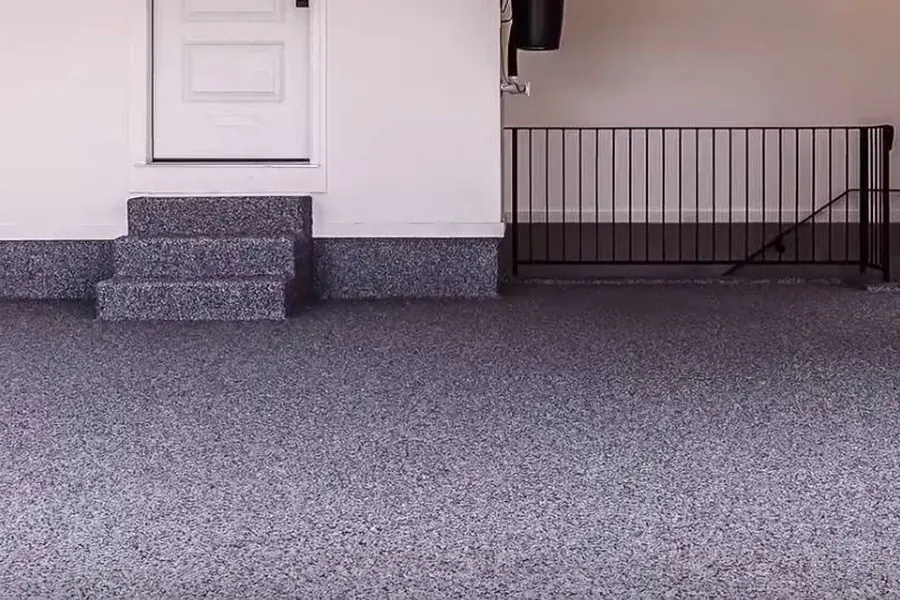
The system on top still matters. A flake floor here is an epoxy base coat soaked into the ground slab, a full broadcast of vinyl flake, and a protective clear topcoat with enough film build to carry tires and spills, with a slip-resistant additive available for the wet strip by the door. Hot tires can still leave marks on a sound floor, and those clean off. Our comparison guide covers how the main coating types differ; ask us which one fits your slab.
Cause 4: Salt and Freeze–Thaw Under an Edge
City trucks and IDOT trucks together put hundreds of thousands of tons of salt on Chicago-area roads in a winter, and many suburbs lay down brine before a storm as well, so a car coming home to Schaumburg or to a city alley carries the same slush. On a coating that is bonded edge to edge, all of it stays on the surface. The damage starts wherever the bond is broken: a chip, a thin feathered edge at the door seal, a patch that never took. Salty water gets under the edge, freezes overnight, thaws by afternoon and lifts the coating a fraction more each time. That is why a threshold failure tends to show up after the first or second winter; the flaw was built in on installation day and the cold simply found it.
The apron outside is a different case. It is bare concrete, and the ready-mixed concrete industry’s guidance describes exactly what happens to it: scaling, the flaking of the surface under freeze–thaw, made worse by de-icing chemicals and worst of all on concrete that was poorly finished or cured, or salted heavily while new. A garage floor coating inside the door does nothing for the apron, so if it bothers you, raise it at the estimate.
Seeing Lifting by the Door?
Book a free on-site visit. You will hear whether a spot repair is enough or the floor needs a full recoat, with no obligation either way.
What to Ask Before You Hire Anyone
- “What happens to the concrete before you coat it?” You want to hear diamond grinding, then crack and joint repair. A pressure wash is cleaning, not prep.
- “Do you check the slab for moisture, and what if it is damp?” The answer should be yes, followed by a plan.
- “Which topcoat, and why that one for a garage?” Listen for sun, hot tires and salty slush in the reasoning.
- “What do you do differently at the door?” If the threshold gets the same answer as the middle of the floor, keep looking.
What a full system costs, and why, is covered in the Chicago epoxy cost guide.
How the Threshold Gets Built
- Walk the slab and the door edge, looking for old coating, scaling and cracks.
- Measure the slab for moisture.
- Diamond grind every square foot, out to the door edge and under the seal.
- Fill cracks, rebuild broken joints and patch scaled areas until the edge is solid.
- Lay the epoxy base coat and broadcast the flake, for a flake floor.
- Finish with the protective clear topcoat, with a slip-resistant additive if you asked for one.
One to two days covers most garage floors. The crew tells you when the floor can take foot traffic and when the car can come back in.
Repairing a Peeling Threshold
A peeling threshold can usually be saved, but never by painting over it: anything applied on top of loose coating comes off with it. The repair starts by cutting the coating back to where it is still tight to the slab, then grinding and patching the exposed concrete and recoating the strip so it blends into the rest of the floor. If the lifting has spread across much of the floor, or moisture is driving it, taking the old coating off completely and starting again is the sounder choice. Floors another crew got wrong are a regular part of the work here; one homeowner wrote in a Google review: “I highly recommend this epoxy company. Very happy how they fixed our epoxy that unfortunately was not properly done by another contractor. Carlos and his team went above and beyond working on our project.” (Augusta J., Google review). Which repair applies becomes clear once the floor has been seen. The repair and recoat service page has more.
Frequently Asked Questions
Why is the coating lifting just inside my garage door?
Because nothing else on the floor gets that combination: salt slush, standing meltwater, freeze–thaw at the open door and every tire turning on it. Whatever weak point the installation left, a poor bond, a damp slab, a thin coat, shows there first, and once an edge lifts, water freezing beneath it levers it up further each cold night.
How soon does a poorly installed floor start peeling?
No fixed schedule, but it is usually the first or second winter. A flaw left at installation sits quietly until salty meltwater reaches it, and Chicago supplies that from late October on.
What topcoat should go on the strip by the door?
On a flake floor, a protective clear topcoat over the epoxy base, with a slip-resistant additive if you want footing on the wet strip. The topcoat matters less at the door than the bond underneath it, and that bond comes from diamond grinding the slab. Ask us which topcoat suits your floor.
Does road salt cause the peeling?
Not on its own. Salt finds the chip, the feathered edge or the patch that never bonded, and works on that. On a floor that was ground and coated properly the salt stays on top and rinses off.
Why is the apron outside my garage door flaking?
That is scaling: freeze–thaw damage to bare concrete, which the ready-mixed concrete industry’s own guidance says de-icing salts make worse. A garage coating ends at the door. If the apron bothers you, raise it at the free estimate.
Can just the peeling strip be repaired?
Usually. The loose material is cut back to a firm edge, the exposed slab is ground and patched, and the strip is recoated to blend in. When the lifting covers much of the floor, or moisture is driving it, the whole coating comes off and the floor is redone.