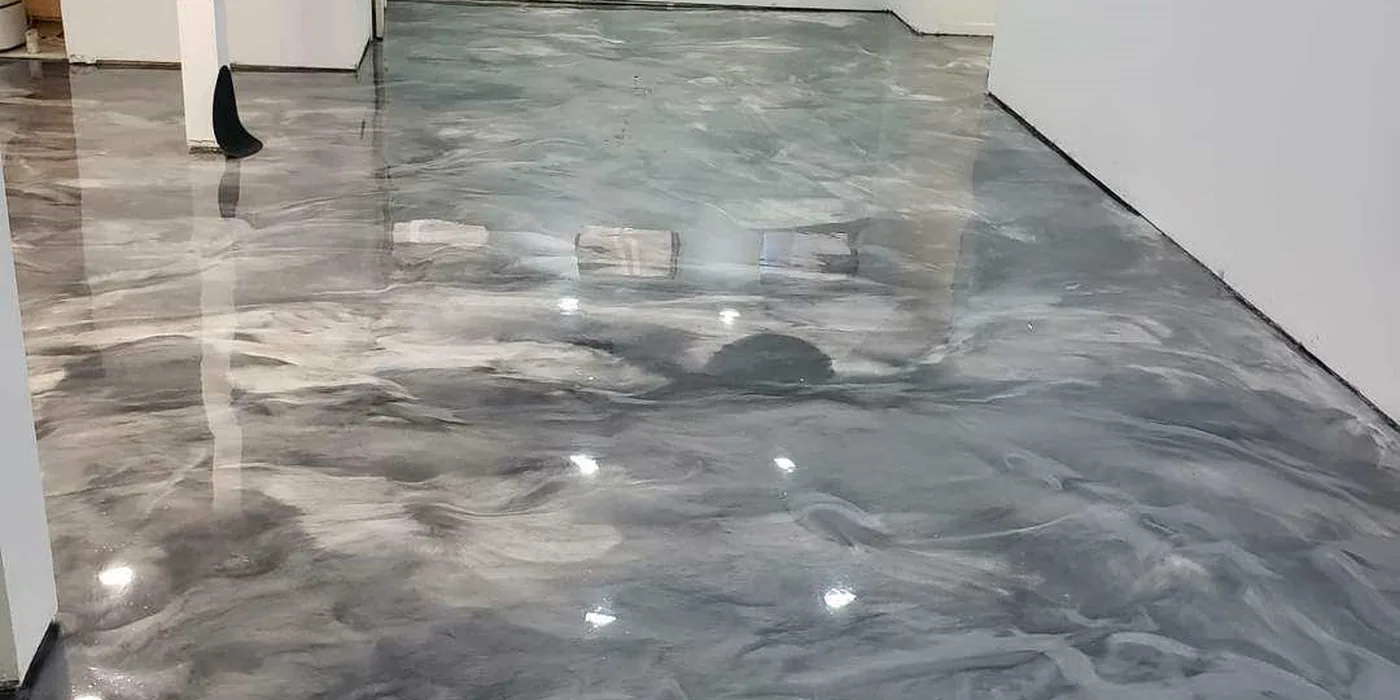
Metallic epoxy turns a concrete floor into something that looks poured, polished and lit from underneath, with veins and ripples that shift as you walk across it. It is the finish Chicago homeowners ask for in finished basements, rec rooms and home bars, and the one shop owners want where the floor is part of the display. Of the three finishes we install, metallic, flake and solid color, it takes the most hand-work, so a little planning pays off. Below: how the finish is made, the rooms it suits, how it compares with flake and solid color, and how to choose colors for metallic epoxy flooring in Chicago.
How a Metallic Floor Is Made
The groundwork is the same as for every coating: the slab is ground to open the surface, cracks and spalls are filled, and the concrete is checked for moisture. Then a tinted base coat goes down, followed by a clear epoxy carrying metallic pigment. While that layer is still wet, Carlos works the pigment by hand into veins, clouds and ripples, and a clear topcoat in the sheen you chose locks the pattern in.
Because the pattern is formed by hand in a wet layer, no two metallic floors come out the same. You set the palette and the mood, from a soft, smoky wash to a bold marble, but not the exact placement of every vein. For most owners that is the whole appeal; it is still worth knowing before you choose.
Bungalow, Two-Flat and Suburban Basements
Chicago is a basement city. More than 80,000 brick bungalows still stand in the Bungalow Belt, each over a full basement, and the city has more than 76,000 two-flats on top of that; the 1970s–90s subdivisions out in Arlington Heights, Schaumburg and Naperville added plenty more. Whatever is upstairs, a basement usually feels unfinished because of its floor, and few finishes change a room as much as metallic. The way it throws light around helps a space with small windows stop feeling like a cellar. One homeowner's Google review:
“The transformation of my basement after the epoxy flooring installation is incredible. The team worked quickly and effectively to achieve a stunning outcome.”
— Evgeny L., Google review
Two practical things come first below grade. Moisture is one: vapor rising through a slab can lift any coating, so the concrete is checked before work starts. Chicago basements also take sewer backups and seepage in heavy summer storms, and a coating does nothing to keep that water out, so any drainage problem is fixed beforehand. Footing is the other: a glossy metallic surface can be slick when wet, and a slip-resistant additive can be mixed into the topcoat.
Because it is a hand-worked finish, metallic is quoted once the room has been seen and the look you want has been talked through.
Rec Rooms, Home Bars and Showrooms
Metallic belongs in rooms where the floor is meant to be noticed: the rec room under a two-flat, a basement bar, a media room, a showroom or a retail floor. The reflective surface makes a small room read larger and gives a display space a deliberate, designed feel. For a business the hard part is usually the calendar, since opening dates don't move, so the schedule is settled at the site visit.
Shops often put metallic only where customers walk and a tougher, textured solid-color floor in the stockroom and the back of house. Our commercial flooring guide walks through how those choices get made.
Metallic vs. Flake vs. Solid Color
We install three finishes, and the choice usually comes down to how the room is used:
| Feature | Metallic | Flake | Solid color |
|---|---|---|---|
| Appearance | Marbled, veined, deep | Speckled, like terrazzo or granite | One even color |
| Dust and tire marks | Shows them | Hides them well | Shows them |
| Footing when wet | Add a slip-resistant additive | Some grip from the chips | Add a slip-resistant additive |
| Where it fits | Basements, rec rooms, showrooms | Garages, workshops, basements | Warehouses, workshops, utility rooms |
| Pattern | Worked by hand, one of a kind | Chips broadcast at the density you choose | None |
Can't decide? Let the room's job decide. A garage you park in every day leans flake; a basement for movie nights, or a floor that's meant to impress, is where metallic belongs.
Try finishes on a floor like yours and get a ballpark figure with your free-estimate request.
Open Floor Studio →Should Metallic Go in the Garage?
It can, and under good lighting it looks spectacular, but weigh a few things first. Dust and tire marks show on a smooth metallic surface sooner than on flake, and snowmelt calls for a slip-resistant additive. Winter is long here: O'Hare sits at or below freezing on about 121 nights a year and gets about 38 inches of snow, and the salt slush your tires carry in lands on the floor, so plan on squeegeeing and rinsing the strip by the door from late October to mid-April. That is why many owners put flake in the garage and keep metallic for downstairs.
Picking Colors and a Sheen
Every metallic color pairs a base tone with one or more pigments, and the range is wide. The directions Chicago homeowners pick most:
- Silver and gray blends for a cool, stone-like room; dark gray metallic is a basement favorite.
- Copper, bronze and warm brown to sit with oak trim and warm lamps.
- Navy, deep blue and charcoal for a bar or a media room.
- Pearl and white blends to lift a showroom or a low basement.
Have a look in mind already? Bring a photo to the estimate and the installer can work toward it. Sheen changes the effect as much as color: high gloss shows the most depth, while semi-gloss and matte hide dust and footprints better. You can try combinations ahead of time in our Floor Studio.
What Sets the Scope of the Job
- The footprint. One open room goes faster than a basement cut up by support posts, closets and a furnace room.
- The slab. Cracks, old paint, tile mastic and damp spots each add prep.
- The design. Each extra color and each extra pass of hand-work adds time.
- Topcoat and grip. Sheen and texture are matched to how the room will be used.
Because the hand-work varies from room to room, the schedule for a metallic floor is set at the estimate; as a reference point, most garage floors are done in one to two days. Our cost guide explains what shapes the quote for every kind of floor.
Picturing a Metallic Floor Downstairs?
Bring color ideas or a photo of a floor you love to a free on-site estimate. We check the concrete, talk through the options and quote the room.
Questions About Metallic Floors
Does metallic epoxy work in a basement?
It's where metallic does its best work. The slab gets a moisture check first, since vapor rising through concrete can lift any coating, and a slip-resistant additive can go into the topcoat if the floor might get damp. A coating doesn't keep water out, so any backup or seepage problem has to be fixed first.
What does a metallic epoxy floor cost in Chicago?
Metallic is a hand-worked finish, so it's quoted by the size of the room, the condition of the concrete and the design you choose, after a free on-site estimate.
Is a metallic floor slippery?
A glossy surface can be slick when wet. Slip-resistant additives go into the topcoat, and they're a good idea in basements, garages and anywhere water might reach the floor.
Can I pick the exact pattern?
You pick the palette and the overall style, soft and cloudy or bold and marbled. The pattern itself forms as the pigment is worked by hand in the wet coat, so no two floors match. Bring a photo of a look you like and we can aim for it.
Metallic or flake for my garage?
For a garage you park in every day, flake usually wins: it hides dust and tire marks and has a little texture of its own. Metallic can work with good lighting and a slip-resistant additive, but most Chicago homeowners put flake in the garage and metallic in the basement.
Do you put metallic floors in stores and showrooms?
Yes. Metallic suits the customer-facing side of a showroom or shop, with a tougher solid-color floor in the back. Scheduling is worked out at the site visit, and every commercial project gets its own quote.
Related Articles
Epoxy Flooring Cost in Chicago: What Sets Your Price (2026)
Size, slab condition, system and finish: the factors behind a Chicago garage or basement floor quote.
Epoxy vs. Polyaspartic for a Chicago Garage: An Honest Comparison
How the two coatings differ, and what salt slush, cold slabs and hot tires ask of a Chicago garage floor.
Commercial Epoxy Flooring in Chicago: Which Floor Fits Your Business?
Which finish suits a warehouse, shop, office, restaurant or service bay, and how a Chicago business floor is scheduled and quoted.